

Claudeforce: What Happens When Claude Meets Salesforce?
Salesforce has been investing heavily in AI over the past few years, from Einstein to Agentforce. Now, another major development is bringing generative AI even closer to everyday CRM work: Claudeforce.
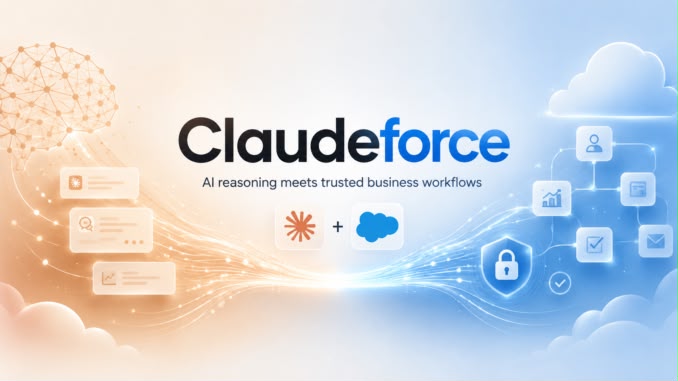
Announced in August 2026, Claudeforce is an expanded partnership between Salesforce and Anthropic that connects Claude’s AI reasoning capabilities with Salesforce data, workflows, business logic, and security controls.
But what does that actually mean for Salesforce users?
What is Claudeforce?
Claudeforce isn't simply another chatbot embedded inside Salesforce.
The idea is to allow Claude to work directly with Salesforce business context. Instead of copying information from Salesforce into an AI assistant, asking a question, and then returning to Salesforce to update a record, users can work with Salesforce information directly through Claude.
The first product from the partnership is called Salesforce in Claude.
According to Salesforce, it launches with 37 prebuilt sales skills designed around activities such as meeting preparation, deal health reviews, pipeline reviews, and updating CRM information.
For example, a salesperson could ask:
"Which of my opportunities need attention this week?"
Claude could reason across the relevant Salesforce context, identify the deals that need attention, explain why, and help the seller take the appropriate next action. That represents an important shift: AI is moving from simply answering questions about CRM data toward working with CRM data and processes.
From Navigating Salesforce to Asking Salesforce
Traditionally, finding an answer in Salesforce often means navigating through objects, reports, dashboards, related lists, and individual records.
Imagine preparing for a customer meeting.
A salesperson might normally open the Account, review Opportunities, check previous activities, look at Tasks, read notes, and perhaps open a dashboard to understand the overall relationship.
With Salesforce in Claude, the interaction could become much more conversational.
A user could ask Claude to summarize the account, identify open opportunities, highlight recent interactions, and point out anything that deserves attention before the meeting.
The underlying Salesforce data remains important. What changes is the interface through which the user interacts with it.
How Does Claude Connect to Salesforce?
An interesting part of Claudeforce is what happens behind the scenes.
Salesforce says the connection is enabled through its enterprise AI architecture, including Headless 360 and Salesforce's broader AIforce capabilities. These expose Salesforce data, workflows, business logic, and permissions so that AI systems can access approved capabilities through technologies such as APIs and Model Context Protocol (MCP).
This means Claude isn't intended to operate as an unrestricted external AI with unlimited access to an organisation's CRM.
Salesforce says actions are routed through Salesforce so that existing permissions and business rules continue to apply. Organisations can also control how much autonomy Claude receives when it comes to writing information back into Salesforce.
This is particularly important because enterprise AI isn't only about giving a model access to information. It is also about determining what the AI is allowed to see and what it is allowed to do.
Why Is This Different From Agentforce?
At first glance, Claudeforce may sound very similar to Agentforce.
There is some overlap, but the concepts are different.
Agentforce focuses on creating and running AI agents connected to Salesforce processes and data.
Claudeforce is the broader Salesforce–Anthropic partnership, with Salesforce in Claude bringing Salesforce capabilities directly into the Claude experience.
In other words, instead of thinking only about:
AI inside Salesforce
we are increasingly moving toward:
Salesforce capabilities inside AI.
That distinction could become increasingly important as users spend more of their working day interacting with AI assistants rather than navigating individual applications.
What Could This Mean for Salesforce Admins and Developers?
Claudeforce does not make good Salesforce architecture less important. It may actually make it more important.
AI is only as useful as the business context it can access.
If an organisation has inconsistent data, unclear ownership, duplicate records, incorrect permissions, outdated automation, or poorly defined processes, giving an AI assistant access to those systems doesn't automatically solve those problems.
It can expose them.
For Salesforce teams, this means areas such as data quality, permission design, automation, object relationships, governance, and business rules may become even more important in an AI-driven Salesforce environment.
The role of an admin or developer may therefore gradually shift from simply designing interfaces and automation toward designing an environment that both humans and AI agents can understand and safely operate within.
What About CRM Analytics and Tableau?
There is also an interesting analytics angle.
Salesforce's Claudeforce announcement specifically references Data 360 and Tableau as parts of the broader platform supporting these AI experiences.
Today, analysts often build datasets, recipes, calculated fields, SAQL queries, dashboards, and filters so that users can explore business information themselves.
AI creates another possible interaction model.
Instead of only opening a dashboard and applying filters, a business user could increasingly start with a question:
"Why did our lead conversion rate decrease compared with last month?"
The AI could potentially reason across governed Salesforce and analytics context and then help the user investigate the underlying data.
That doesn't necessarily replace dashboards. Dashboards remain valuable for monitoring KPIs and communicating a consistent view of performance.
But AI could become another layer on top of analytics: dashboards show what is happening, while AI helps users investigate what they should look at next.
The Bigger Picture
Claudeforce is part of a broader change happening across Salesforce.
Salesforce is increasingly describing enterprise software as moving from applications that users manually navigate toward systems whose data, rules, and actions can also be accessed by AI agents. Its recent Agentforce announcements follow the same direction.
For Salesforce professionals, that makes the next phase particularly interesting.
Learning Salesforce may no longer mean only understanding objects, Flow, Apex, integrations, reports, and CRM Analytics.
It may also mean understanding agents, context, MCP, AI permissions, grounding, governance, and how Salesforce data should be structured so AI can reason over it effectively.
Final Thoughts
Claudeforce is still new, and Salesforce in Claude is only beginning its rollout, so its real impact will depend on how organisations adopt it once broader access becomes available.
But the direction is already clear.
Salesforce is moving beyond simply adding AI features to individual screens. It is working toward a model where AI can interact directly with the data, workflows, permissions, and business logic that make up the Salesforce platform.
For Salesforce professionals, the interesting question may therefore be less:
“Will AI change how we use Salesforce?”
and more:
“How will the way we design Salesforce need to evolve as AI agents become part of everyday work?”