How Salesforce is Redefining Corporate Labor and the Future of AI
For the past few years, the narrative surrounding Artificial Intelligence (AI) in the enterprise sector has been dominated by generative chat interfaces. The paradigm was simple and reactive: a human operator initiated a prompt, and a Large Language Model (LLM) generated a response. While transformative, this phase represented a conversational middle-ground rather than a true operational revolution.
Today, the tech industry is undergoing a monumental shift from passive chatbots to autonomous AI agents—a transition spearheaded by Salesforce and its Agentforce platform. This essay argues that the rise of the "Agentic Enterprise" represents a fundamental rewrite of corporate labor. By shifting AI from an assistive tool to an independent digital workforce, platforms like Salesforce are unlocking unprecedented efficiency, but they are also forcing a critical re-examination of data ethics, corporate governance, and the future of human employment.
Defining the Agent: From Co-Pilots to Autonomous Actors
To understand the significance of this technological leap, one must distinguish between traditional automation, conversational co-pilots, and autonomous agents. Traditional software automation relies on rigid, "if-this-then-that" logic. If a customer fills out a form, the system routes it to a sales representative. Copilots advanced this by summarizing data or drafting emails, but they still required constant human oversight and iterative prompting.
Autonomous agents, however, operate on a paradigm of delegated intent. Instead of being told how to do a task step-by-step, an agent is given a goal—such as "optimize this client’s renewing contract to maximize retention while maintaining a 15% margin." Utilizing advanced reasoning loops, the agent can independently analyze historical data, formulate a multi-step execution plan, interact with the client via natural language, and update the CRM infrastructure without human intervention. Salesforce has embedded this capability directly into its core ecosystem, effectively turning the CRM from a passive system of record into an active ecosystem of execution.
The Engine Behind the Agent: Data Cloud and the Trust Layer
An autonomous agent is only as competent as the data environment it inhabits. In an enterprise setting, an AI cannot afford to "hallucinate" or fabricate information, as a single erroneous contract detail can result in severe financial or legal liabilities. To solve this, Salesforce relies heavily on its Data Cloud architecture.

Data Cloud serves as the foundational "brain," harmonizing scattered, unstructured information—such as internal emails, legacy SQL databases, PDFs, and Slack conversations—into a single, real-time source of truth. When an Agentforce agent executes a task, it uses Retrieval-Augmented Generation (RAG) to pull context strictly from this verified corporate data lake.
Furthermore, this architecture addresses the profound ethical dilemma of enterprise data privacy through the Salesforce Trust Layer. This security framework acts as a strict guardrail: it masks personally identifiable information (PII) before passing data to external LLMs, prevents public models from retaining proprietary corporate data for training purposes, and logs every automated action for human auditing. This balance between deep contextual awareness and strict data compliance is what separates casual consumer AI from enterprise-ready automation.
The Socio-Economic Impact: The Future of White-Collar Labor
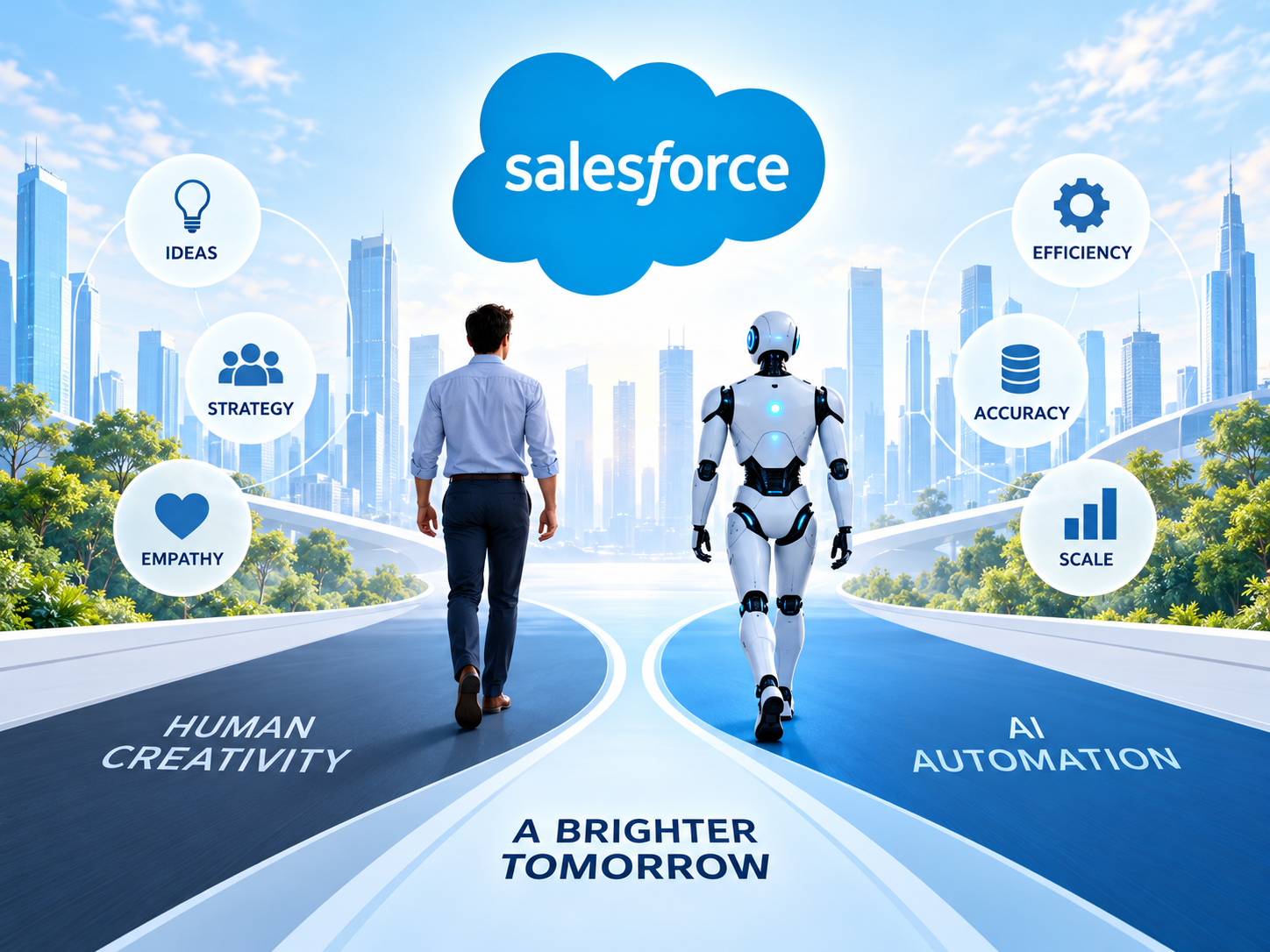
The evolution toward autonomous enterprises inevitably sparks a tense debate regarding the future of work. Technologists frequently champion a harmonious view of "human-AI symbiosis." In this idealized framework, agents absorb the mundane, repetitive, and time-consuming tasks—such as updating pipelines, scheduling follow-ups, and resolving tier-one customer service disputes. This, in theory, liberates human workers to focus on higher-value cognitive tasks: strategic planning, creative problem solving, and complex, high-empathy relationship management.
However, a more critical economic analysis reveals a potential disruption to the white-collar job market, particularly for entry-level positions. Historically, roles in customer support, basic data analysis, and junior sales outreach served as the essential proving grounds for young professionals entering the corporate world. If an army of digital agents can handle thousands of these interactions simultaneously, at a fraction of the cost, the corporate ladder loses its lowest rungs. Organizations face the risk of creating a skills gap, where entry-level roles disappear, leaving no clear pathway for novice workers to develop the institutional knowledge required for senior, strategic roles.
Conclusion
Salesforce’s aggressive pivot toward autonomous agents marks the definitive end of the experimental era of generative AI. Enterprise AI has transitioned from an intriguing novelty into critical economic infrastructure. As organizations rapidly adopt platforms like Agentforce, the metric of business success will no longer be determined by how many software applications a company owns, but by how seamlessly it orchestrates collaboration between its human workforce and its digital agents. The true corporate challenge of the coming decade will not be technological adoption, but governance—ensuring that as our systems become entirely autonomous, they remain ethically aligned, secure, and ultimately designed to augment, rather than entirely erase, the value of human ingenuity.